The Complete SEO Checklist for Maximizing Google PMax and AI Max ROI in 2025
Industry: Marketing
For years, the concept of ‘synergy’ between paid media and organic search teams remained more aspirational than practical. Teams worked in silos, shared minimal insights, and rarely collaborated beyond occasional keyword discussions. However, with the rise of Google’s Performance Max (PMax) and the newly launched AI Max for Search Campaigns, that siloed approach is no longer viable; it’s actively costing you money.
Here’s the fundamental shift: Your website is no longer just a destination for ad traffic. Instead, it’s the primary source material that Google’s AI uses to create, optimise, and deliver your advertisements across its entire ecosystem. When your website content is thin, poorly structured, or technically flawed, the AI generates low-quality, generic ads that waste your budget. Conversely, when your site is strategically optimised, the AI creates compelling, highly relevant ads that dramatically improve your return on ad spend (ROAS).
At WEBSIGH, we’ve discovered that one of the biggest levers for improving PMax and AI Max performance isn’t budget increases or bid adjustments, it’s strategic website optimisation guided by expert SEO implementation. This revelation has transformed how we approach paid campaign success for our clients.
Understanding Google PMax and AI Max: The AI Revolution in Paid Advertising
Before diving into optimization strategies, let’s establish clear understanding of these transformative platforms:
Google Performance Max (PMax): A single, AI-driven campaign type that automatically serves ads across all Google surfaces—Search, YouTube, Display, Discover, Gmail, and Maps. Rather than creating separate campaigns for each channel, PMax uses machine learning to optimize placements, audiences, and creative assets simultaneously across the entire Google ecosystem.
AI Max for Search Campaigns: An opt-in enhancement within standard Search campaigns that leverages Google’s latest AI-driven optimizations. It broadens query matching capabilities and dynamically adapts your ad assets while retaining your classic keyword structure and control.
How These AI-Powered Campaigns Actually Work
Both platforms rely heavily on the quality, structure, and technical health of your website’s content to create ads, determine relevance, and select landing pages. The AI scans your website to understand:
- What products or services do you offer
- How to describe your value propositions
- Which pages best match specific user queries
- What visual assets represent your brand
- How users should navigate your conversion funnel
Consequently, if your website presents a confusing, slow, or poorly organised experience, the AI creates messy, low-performing advertisements that fail to convert. The quality of your ads is fundamentally limited by the quality of your website.
This guide provides an actionable, 8-step blueprint for transforming traditional SEO tasks into direct, high-impact improvements for your paid AI campaigns. Moreover, we’ll outline the common, costly mistakes to avoid in each step so you can stop wasting budget and start converting at higher rates.
Why This SEO-Paid Synergy Matters More Than Ever
Traditional paid advertising allowed you to compensate for website weaknesses through better ad copy, precise targeting, or higher bids. AI-driven campaigns operate differently. They amplify whatever exists on your website—both strengths and weaknesses.
The amplification effect works in both directions:
Positive amplification: Well-structured, conversion-optimized pages with rich content enable AI to create dozens of high-performing ad variations that target nuanced user intents you might never manually consider.
Negative amplification: Poorly optimized pages force AI to work with limited, low-quality source material, resulting in generic ads that fail to differentiate your brand or compel action.
Furthermore, the financial impact is substantial. WEBSIGH clients who implement our comprehensive SEO optimisation before launching PMax campaigns consistently see 40-60% higher ROAS compared to those who launch campaigns with unoptimized websites.
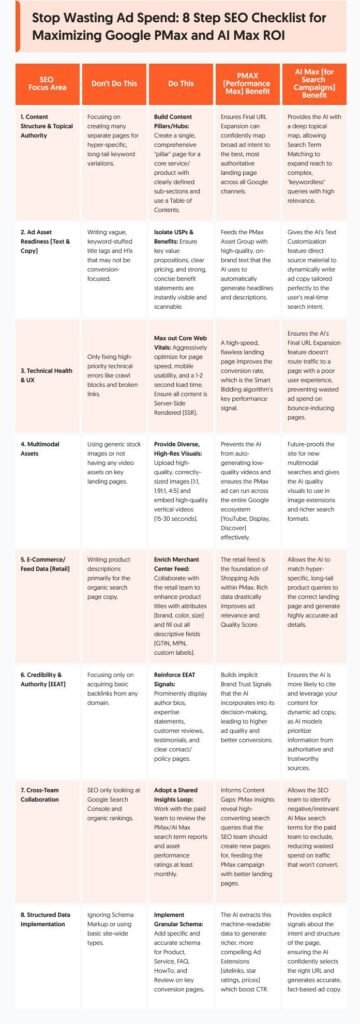
The 8-Step SEO Blueprint for Maximum PMax and AI Max Performance
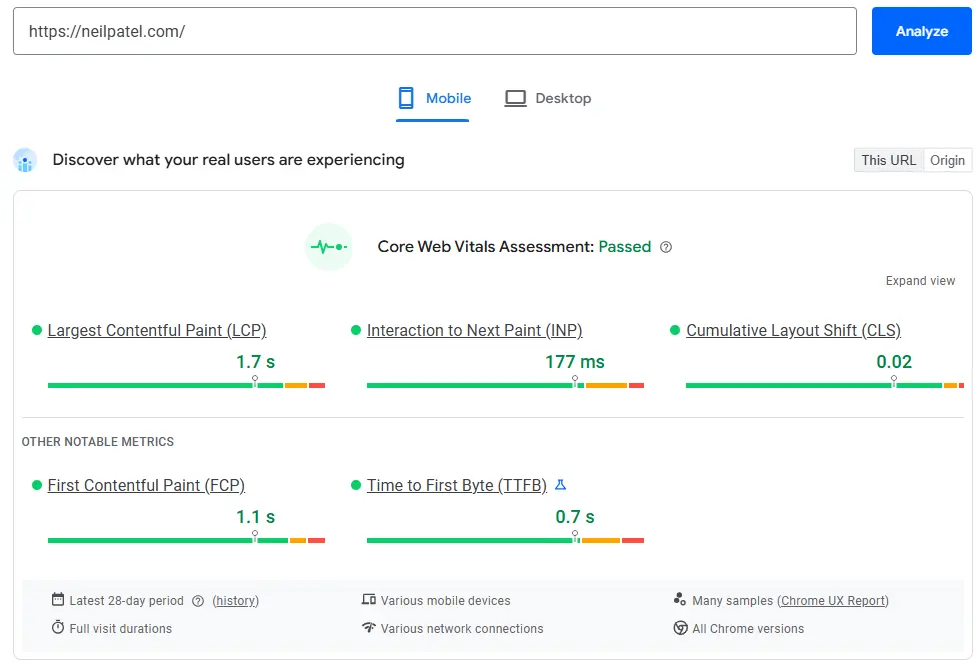
Step 1: Optimise Technical Health and User Experience
Why This Matters: Poor landing page experience directly impairs Smart Bidding’s most critical signal: Conversion Rate (CVR). Speed issues cause users to abandon your funnel, wasting every advertising dollar spent on that click. Additionally, since both platforms use automated URL Expansion (sending users to the best-fit page when enabled), technical problems on any page can sabotage campaign performance.
Common Mistake: Only fixing high-priority technical errors like crawl blocks (accidental Disallow rules in robots.txt or misapplied noindex tags) and broken links while ignoring performance optimisation.
WEBSIGH Recommendation: Aggressively maximise Core Web Vitals by optimising for exceptional page speed and mobile usability. Aim for 1-2 second load times across all devices. While Server-Side Rendering (SSR) represents the ideal approach for speed, if full SSR isn’t feasible, implement robust site-wide caching and leverage CDN optimisation services to ensure near-instantaneous content display.
Implementation checklist:
✓ Eliminate all crawl errors and broken links
✓ Achieve Largest Contentful Paint (LCP) under 2.5 seconds
✓ Maintain Cumulative Layout Shift (CLS) below 0.1
✓ Ensure First Input Delay (FID) under 100 milliseconds
✓ Optimise images with next-gen formats (WebP, AVIF)
✓ Implement lazy loading for below-the-fold content
✓ Minimise JavaScript execution time
✓ Ensure mobile-first responsive design
PMax Benefit: A high-speed, flawless landing page dramatically improves conversion rate, which serves as Smart Bidding’s key performance signal. Higher conversion rates lead to better ad placements and lower cost-per-acquisition.
AI Max Benefit: Ensures the AI’s Final URL Expansion feature (if enabled) doesn’t route traffic to pages with poor user experiences, preventing wasted spend on bounce-inducing destinations.
Step 2: Provide Multimodal Assets and Rich Media
Why This Matters: Asset quantity and quality are fundamental to PMax’s ability to run effectively across all Google channels—YouTube, Display, Search, Discover, and Gmail. Lacking video assets severely limits PMax reach and forces the AI to auto-generate low-quality, automated videos that poorly represent your brand.
Common Mistake: Using only generic stock images or having no video assets whatsoever on key landing pages, leaving the AI with minimal creative material to work with.
WEBSIGH Recommendation: Provide diverse, high-resolution visuals across multiple aspect ratios. Upload high-quality, correctly-sized images in various formats (1:1 square, 1.91:1 landscape, 4:5 portrait) and embed high-quality vertical videos (15-60 seconds) on your most important landing pages.
Asset specifications for optimal performance:
Images:
- Minimum resolution: 1200 x 1200 pixels
- Multiple aspect ratios: Square (1:1), Landscape (1.91:1), Portrait (4:5)
- High-quality product shots with clean backgrounds
- Lifestyle images showing products in use
- Infographics and branded visual content
Videos:
- Duration: 15-60 seconds optimal
- Vertical format (9:16) for mobile-first display
- Clear brand presence in first 3 seconds
- Captions included (60% of videos watched without sound)
- Compelling hooks that grab attention immediately
PMax Benefit: Prevents the AI from auto-generating low-quality videos and ensures your PMax ads can run effectively across the entire Google ecosystem, including YouTube and Discover, dramatically expanding your reach.
AI Max Benefit: Future-proofs your site for emerging multimodal search experiences and provides the AI with quality visuals for image extensions and richer search formats.
Step 3: Optimise E-Commerce Product Feed Data (For Retail)
Why This Matters: For any retail business, the product feed represents the single most important data source for PMax campaigns. Without a rich, accurate feed, Shopping Ads, a key component of PMax, will not function or perform efficiently, severely limiting your campaign’s effectiveness.
Common Mistake: Writing product descriptions primarily for organic search page copy without considering how that content feeds into advertising systems, resulting in vague titles and incomplete product attributes.
WEBSIGH Recommendation: Collaborate closely with your retail team to substantially enrich your Merchant Centre feed. Enhance product titles with crucial attributes (brand, colour, size, material) and fill every available descriptive field, including GTINs, MPNs, and custom labels.
Product feed optimization priorities:
✓ Detailed product titles: Include brand + product type + key attributes + size/color
✓ Complete GTINs/MPNs: Improves product matching and ad eligibility
✓ Custom labels: Enable sophisticated campaign segmentation and bidding
✓ High-quality images: Multiple angles, zoom capability, lifestyle shots
✓ Comprehensive descriptions: Benefits, features, specifications, use cases
✓ Accurate availability: Real-time stock status prevents advertising unavailable products
✓ Competitive pricing: Regular price audits ensure competitiveness
✓ Product categories: Accurate Google product taxonomy assignment
PMax Benefit: A rich, detailed feed dramatically boosts ad relevance and eligibility across Shopping placements, improving coverage, click-through rates, and overall campaign efficiency.
AI Max Benefit: Allows the AI to accurately match hyper-specific, long-tail product queries to the correct landing pages and generate highly precise ad details that address exact customer needs.
Step 4: Create Ad-Ready Text and Conversion-Focused Copy
Why This Matters: This practice provides the direct, conversion-focused text that AI uses to build dynamic ads. High-quality copy is essential for improving Ad Strength scores and boosting click-through rates across all placements.
Common Mistake: Writing vague, keyword-stuffed title tags and H1 headings that may rank for search but don’t drive conversions or provide clear value propositions that AI can extract for ad creation.
WEBSIGH Recommendation: Isolate and prominently display your unique selling propositions (USPs) and benefits. Ensure key value propositions, clear pricing information, and strong, concise benefit statements are instantly visible above the fold on every landing page.
Conversion-focused content elements:
Headlines and title tags:
- Lead with primary benefit, not just keywords
- Include specific value propositions (e.g., “Free Shipping,” “30-Day Returns”)
- Keep under 60 characters for full display
- Use action-oriented language
Body content structure:
- Benefits before features in every section
- Bullet points for scanability
- Social proof prominently displayed
- Clear, compelling calls-to-action
- Address common objections directly
Pricing and offers:
- Transparent pricing information
- Special offers and discounts clearly stated
- Comparison to competitor pricing when advantageous
- Value justification for premium pricing
PMax Benefit: Feeds the PMax Asset Group with high-quality, on-brand text that the AI uses to automatically generate compelling headlines and descriptions across all Google channels.
AI Max Benefit: Provides the AI’s Text Customisation feature with excellent source material to dynamically write ad copy perfectly tailored to each user’s real-time search query.
Step 5: Implement Comprehensive Structured Data
Why This Matters: Structured data provides machine-readable signals that directly improve the appearance and information quality of your ads, significantly boosting click-through rates and enabling richer ad formats that stand out in search results.
Common Mistake: Ignoring Schema markup entirely or using only basic site-wide types without implementing granular, page-specific schemas that provide detailed context about your content.
WEBSIGH Recommendation: Implement granular, accurate Schema markup for every relevant content type. Add specific schemas for Product, Service, FAQ, HowTo, Review, Organisation, and LocalBusiness on key conversion pages. Ensure all schema is properly validated and free of errors.
Priority schema implementations:
Product Schema: Essential for e-commerce, includes pricing, availability, ratings, and specifications
Service Schema: Describes service offerings with pricing, service areas, and delivery methods
FAQ Schema: Provides question-answer pairs that can appear directly in search results
HowTo Schema: Step-by-step instructions that create rich results and improve visibility
Review Schema: Displays star ratings and review counts in search results
Organisation Schema: Establishes your brand entity with logo, contact info, and social profiles
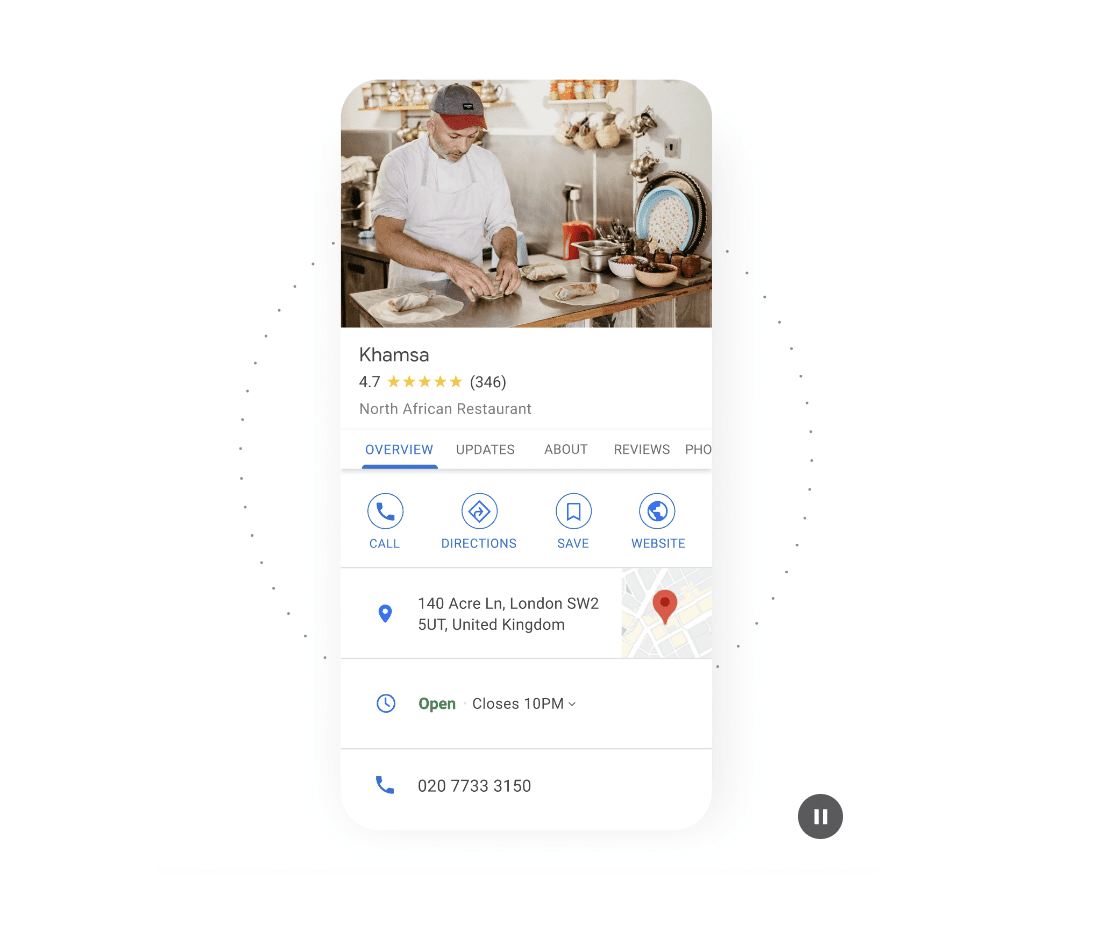
LocalBusiness Schema: Critical for location-based businesses with address, hours, and services
PMax Benefit: The AI extracts this machine-readable data to generate richer, more compelling ad extensions (sitelinks, star ratings, prices, location information) which dramatically boost click-through rates.
AI Max Benefit: Provides explicit signals about page intent and structure, ensuring the AI confidently selects the right URLs and generates accurate, relevant ad copy based on structured information.
Step 6: Build Content Structure and Topical Authority
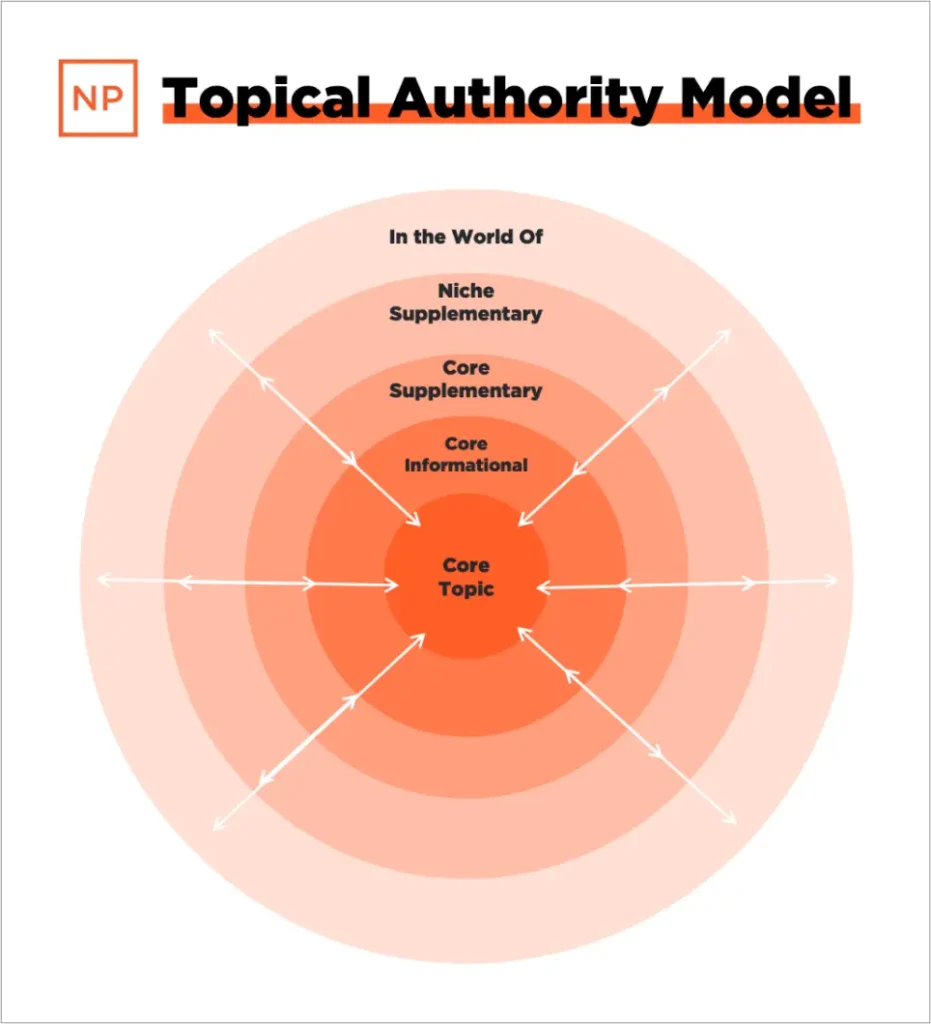
Why This Matters: This shift is crucial for improving long-term content relevance and the accuracy of Final URL Expansion. It ensures the AI can quickly identify the single most authoritative page for any broad search intent, rather than getting confused by multiple thin pages competing for similar queries.
Common Mistake: Creating many separate pages targeting hyper-specific, long-tail keyword variations, resulting in thin content spread across dozens of pages that confuse AI about which page should rank for broader queries.
WEBSIGH Recommendation: Build comprehensive content pillars and topic hubs. Create single, authoritative “pillar” pages for core services or products with clearly defined sub-sections, internal navigation, and comprehensive coverage. Use a detailed Table of Contents structure that makes navigation intuitive.
Content pillar architecture:
Main pillar page structure:
- Comprehensive overview of the broad topic
- 2,500-5,000+ words of in-depth content
- Clear H2 and H3 heading hierarchy
- Interactive Table of Contents with jump links
- Links to supporting cluster content
- Regular updates to maintain freshness
Supporting cluster content:
- Detailed deep-dives into subtopics
- Link back to main pillar page
- Cross-link to related cluster content
- Address specific user questions
- Include unique insights and examples
Internal linking strategy:
- Pillar page links to all cluster content
- Cluster content links back to pillar
- Related cluster pages cross-link strategically
- Use descriptive, keyword-rich anchor text
PMax Benefit: Ensures Final URL Expansion can confidently map broad advertising intent to the best, most authoritative landing page across all Google channels, preventing traffic dispersion across multiple weak pages.
AI Max Benefit: Provides the AI with a clear topical map, allowing Search Term Matching to expand reach to complex, “keywordless” queries with high confidence in URL selection.
Step 7: Strengthen Credibility and E-E-A-T Signals
Why This Matters: E-E-A-T (Experience, Expertise, Authoritativeness, Trustworthiness) signals serve as a critical ranking factor for overall quality and trust. While primarily targeting organic success, these signals implicitly benefit ad quality by building Brand Trust Signals that influence user decisions and AI confidence in recommending your pages.
Common Mistake: Focusing exclusively on acquiring basic backlinks from any available domains without building genuine credibility signals on your own site that demonstrate expertise and trustworthiness.
WEBSIGH Recommendation: Prominently display comprehensive author biographies, expertise statements, customer reviews, testimonials, and clear contact information throughout your site. Ensure all key personnel have detailed, well-linked “About Us” or “Author” pages that establish their qualifications and industry credibility.
Essential E-E-A-T elements:
Author credentials:
- Detailed author bios on all content
- Professional credentials and certifications
- Years of experience in the field
- Links to author social profiles
- Published works and industry recognition
Trust indicators:
- Customer reviews and ratings prominently displayed
- Video testimonials from real customers
- Industry certifications and awards
- Security badges and payment processor logos
- Money-back guarantees and return policies
Contact and transparency:
- Physical business address
- Multiple contact methods (phone, email, chat)
- Responsive customer service information
- Clear privacy and refund policies
- Company leadership profiles
Third-party validation:
- Media mentions and press coverage
- Industry association memberships
- Partner and supplier logos
- Case studies with verifiable results
- Links from authoritative industry sites
PMax Benefit: Builds implicit Brand Trust Signals that the AI incorporates into its decision-making algorithms, leading to higher perceived ad quality and better conversion rates from users who trust your brand.
AI Max Benefit: Ensures the AI is more likely to cite and leverage your content for dynamic ad copy generation, as AI models systematically prioritize information from authoritative, trustworthy sources.
Step 8: Establish Cross-Team Collaboration and Feedback Loops
Why This Matters: This represents the operational foundation that enables the previous seven factors to be consistently implemented and optimised. It transforms isolated marketing efforts into a scalable, self-improving marketing machine that compounds performance gains over time.
Common Mistake: SEO teams only look at Google Search Console and organic rankings while paid teams focus exclusively on campaign dashboards, resulting in missed opportunities and duplicated efforts.
WEBSIGH Recommendation: Adopt a shared insights loop where SEO and paid teams meet regularly to review PMax/AI Max search term reports and asset performance data together. Create monthly cross-functional meetings with clear agendas and action items.
Collaboration framework:
Weekly tactical sync:
- Review performance anomalies requiring immediate attention
- Share quick wins and testing results
- Coordinate content updates and new page launches
- Align on priority optimisation targets
Monthly strategic review:
- Analyze search term reports for content gap opportunities
- Evaluate asset performance across campaigns
- Identify negative/irrelevant terms for exclusion
- Plan content roadmap based on paid insights
Quarterly planning sessions:
- Review overall ROAS and efficiency metrics
- Set shared goals and success metrics
- Allocate resources for major initiatives
- Evaluate competitive landscape changes
Shared documentation:
- Central keyword and topic tracking spreadsheet
- Content calendar with SEO and paid coordination
- Technical issue log with priority assignments
- Performance dashboard accessible to both teams
PMax Benefit: Informs content gaps by revealing high-converting search queries from PMax reports that the SEO team should create new pages for, feeding the campaign with progressively better landing pages over time.
AI Max Benefit: Allows the SEO team to identify negative or irrelevant AI Max search terms for the paid team to exclude, directly reducing wasted spend on traffic that won’t convert.
14. Analyse Competitor Backlink Profiles Strategically
Your competitors’ backlinks provide a detailed roadmap for your own link-building strategy. If specific tactics work for them, they’ll likely work for you, often even better if you improve upon their execution.
Competitive backlink analysis process:
1. Gather Intelligence:
- Use Ubersuggest, Ahrefs, or Semrush to pull comprehensive competitor backlink reports
- Examine which pages earn the most links (homepage, blog posts, resources)
- Identify their most valuable referring domains
- Analyse referral patterns to spot systematic link-building strategies
2. Identify Patterns:
- Are they earning links primarily from industry directories?
- Do they use guest posting extensively?
- Have they published data-driven reports that attracted media coverage?
- Are they leveraging specific partnerships or sponsorships?
3. Create Superior Alternatives:
Ask yourself: “Can I create something significantly better than what earned them that backlink?”
If your competitor earned links for “2024 Social Media Trends,” publish a deeper “2025 Social Media Playbook” with more actionable insights, original data, and better design. Then pitch it to the same sites that linked to their inferior resource.
The key principle: Competitor backlinks aren’t just insights, they’re valuable opportunities for growth and measurable wins. Every quality link they have represents a site that’s already demonstrated interest in your topic and willingness to link to relevant resources.
Common Costly Mistakes That Sabotage PMax and AI Max Performance
❌ Launching campaigns before website optimization: Starting PMax or AI Max with an unoptimized website forces AI to work with poor source material, requiring expensive learning phases and wasting budget.
❌ Treating PMax like a traditional campaign: Trying to manually control every aspect defeats the purpose of AI optimization. Instead, focus on providing excellent website assets and letting the AI do its work.
❌ Ignoring asset diversity: Running campaigns with only text ads or limited images severely restricts where your ads can appear, missing valuable opportunities across YouTube, Display, and Discover.
❌ Poor product feed hygiene: Incomplete or inaccurate product feeds cause disapprovals, limit ad reach, and reduce relevance scores, directly harming performance.
❌ No cross-team communication: When SEO and paid teams work in silos, both miss critical insights that could dramatically improve performance for minimal additional investment.
❌ Inadequate conversion tracking: Without proper conversion tracking setup, Smart Bidding cannot optimize effectively, essentially flying blind.
❌ Insufficient learning period: Making frequent campaign changes or pausing campaigns before they complete the learning phase prevents AI from reaching optimal performance.
❌ Weak calls-to-action: Vague or buried CTAs on landing pages prevent the AI from understanding and communicating your conversion goal effectively.
Measuring Success: Key Metrics for SEO-Optimized AI Campaigns
Traditional campaign metrics remain important, but SEO-optimized AI campaigns require additional measurement approaches that capture the full value of your optimization efforts.
Primary performance metrics:
Return on Ad Spend (ROAS): The ultimate measure of campaign profitability, comparing revenue generated to advertising costs
Conversion Rate: The critical signal that Smart Bidding optimizes against, directly reflecting landing page quality
Cost Per Acquisition (CPA): How much you spend to acquire each customer, customer should decrease as optimization improves
Click-Through Rate (CTR): Indicates ad relevance and quality, typically improves with better website assets
Impression Share: Percentage of available impressions you’re capturing, should increase as ad quality improves
Secondary optimization metrics:
Ad Strength Score: Google’s assessment of asset quality and diversity, target “Excellent” ratings
Page Experience Signals: Core Web Vitals scores directly correlating with conversion performance
Asset Performance Ratings: Individual ratings for headlines, descriptions, images, and videos
Search Term Quality: Relevance of queries triggering your ads, improves with better content structure
URL Expansion Accuracy: How often Final URL Expansion selects the optimal landing page
Cross-team impact metrics:
Content Gap Fill Rate: New pages created based on paid search insights
Technical Issue Resolution Time: Speed of fixing problems identified through campaign performance
Asset Update Frequency: How often you refresh creative based on performance data
Shared Goal Achievement: Progress on mutually agreed objectives between teams
Implementation Timeline: Your 90-Day PMax Optimization Roadmap
Implementing comprehensive optimisation requires systematic execution. Follow this proven timeline for best results:
Phase 1: Foundation (Days 1-30)
Week 1-2: Technical audit and prioritisation
- Conduct a comprehensive technical SEO audit
- Identify and document Core Web Vitals issues
- Catalogue all existing assets (images, videos, copy)
- Review current product feed quality (if applicable)
Week 3-4: Quick wins and critical fixes
- Resolve all crawl errors and broken links
- Implement basic schema on top landing pages
- Optimise highest-traffic page load speeds
- Establish SEO-paid team meeting cadence
Phase 2: Asset Development (Days 31-60)
Week 5-6: Content and copy optimisation
- Rewrite key landing pages with conversion focus
- Create comprehensive content pillars
- Develop diverse image assets in multiple formats
- Produce initial video content for top products/services
Week 7-8: Technical implementation
- Roll out comprehensive schema markup
- Optimize product feed with enhanced attributes
- Implement advanced caching and CDN optimization
- Establish tracking for all key metrics
Phase 3: Optimization and Scale (Days 61-90)
Week 9-10: Campaign refinement
- Analyze early performance data
- Adjust asset mix based on performance ratings
- Expand content coverage to address gaps
- Refine cross-team collaboration processes
Week 11-12: Scale and systematise
- Document successful processes for repeatability
- Expand optimisation to additional landing pages
- Develop ongoing asset creation workflow
- Establish a quarterly strategic planning schedule
Expected outcomes by day 90:
- 40-60% improvement in ROAS
- 25-35% increase in conversion rate
- “Excellent” Ad Strength scores across campaigns
- Established sustainable optimisation framework
Advanced Strategies for Mature Campaigns
Once you’ve implemented the core 8-step framework, these advanced strategies can drive additional performance improvements:
Dynamic Content Personalization
Implement dynamic content that adapts based on user signals (location, device, referral source, time of day). This provides AI with multiple variations to test across different audience segments.
Predictive Asset Testing
Use historical performance data to predict which new assets will perform well before full rollout. Create testing frameworks that validate assumptions quickly.
Competitor Asset Analysis
Regularly analyze competitor ads and landing pages to identify asset gaps in your own campaigns. Adopt and improve upon successful approaches you observe.
Seasonal Content Optimization
Prepare seasonal landing pages and assets in advance, allowing AI sufficient time to learn and optimize before peak demand periods.
Multi-Language and Geo-Specific Optimization
For businesses operating across multiple regions or languages, create properly localized versions of all optimization elements rather than relying on translation alone.
Getting Started: Your Next Steps
The gap between businesses maximizing AI campaign performance and those struggling with mediocre results comes down to one factor: website optimization strategy. Google’s AI is incredibly powerful, but it can only work with the materials your website provides.
Implementing this 8-step framework transforms your website from a passive destination into an active performance engine that continuously feeds better signals into your AI campaigns. The result is higher-quality ads, better audience targeting, improved conversion rates, and dramatically better ROAS.
However, executing this level of optimization requires specialized expertise across both technical SEO and paid advertising. Many businesses lack the internal resources or knowledge to implement these strategies effectively while maintaining daily operations.
Partner With WEBSIGH for Maximum AI Campaign Performance
WEBSIGH’s PMax and AI Max Optimisation Services Include:
✓ Comprehensive technical SEO audit focused on AI campaign requirements
✓ Core Web Vitals optimisation and page speed enhancement
✓ Asset strategy development and creative direction
✓ Structured data implementation across all conversion pages
✓ Content pillar architecture and topical authority building
✓ Product feed optimisation and enrichment (for e-commerce)
✓ Cross-team collaboration framework and process development
✓ Ongoing monitoring, testing, and performance optimisation
Transform Your AI Campaign Performance Today:
📧 Email: info@websigh.com
📞 Phone: +91 (700) 880-7871
🔗 Get Your Free PMax Optimisation Audit: Fill the form below and we will reach out in a heartbeat.
Don’t let poor website optimisation waste your advertising budget. The businesses maximising AI campaign performance in 2025 are those treating their website as a strategic asset that directly powers their advertising success. Let WEBSIGH help you join them.
Additionally, download our comprehensive PMax and AI Max optimisation checklist at [websigh.com/resources/pmax-checklist] for a quick-reference guide to all 8 optimisation steps.
The technology that we use to support you
Ready to reduce your technology cost?

See More Blogs


Let's Make Something Impactful
Call us at: 700-880-7871
- Client-oriented
- Independent
- Competent
- Results-driven
- Problem-solving
- Transparent