Marketing Attribution Blind Spots: What's Changing and How to Close Critical Gaps in 2026
Industry: Marketing

Attribution in today’s marketing landscape feels increasingly confusing and frustrating. Meanwhile, the pressure on marketing teams to “prove what’s working” intensifies with every budget review cycle. Senior leadership wants data-driven answers about marketing ROI, yet the tools and methods we’ve relied on for years are breaking down before our eyes.
Traditionally, marketers could depend on certain reliable data sources to track customer journeys and attribute conversions. Now, however, the data pool we can access seems to be simultaneously expanding and shrinking, a paradoxical situation that’s catching many teams off guard. Between stringent privacy constraints, zero-click searches that never reach your website, AI Overviews that answer questions without clicks, and platform-walled gardens that hoard data, marketers are flying blind in more ways than they realise.
Here’s the uncomfortable truth: Attribution has always been an imperfect science. In 2025, it’s gone from fuzzy to completely fragmented.
If you’re planning marketing budgets right now and trying to defend where your spending goes, there’s no need to panic. Marketing attribution remains possible, but it just doesn’t look anything like it used to. Moreover, if you’re still relying exclusively on touch-based models or last-click reports, you might be measuring the wrong things entirely while making critical business decisions based on incomplete information.
At WEBSIGH, we’ve helped dozens of clients navigate this attribution crisis by building comprehensive measurement frameworks that account for modern realities. The solution isn’t returning to old methods that no longer work; it’s evolving your approach to match how customers actually discover, evaluate, and purchase today.
Let’s break down exactly where attribution is failing, what’s making it harder than ever, and what forward-thinking marketers are doing to close the gap and make confident budget decisions.
Understanding the New Reality of Marketing Attribution
Attribution used to center on stitching together clicks across a customer’s journey. Today, we’re fortunate if we capture clicks at all, thanks to the explosive growth of zero-click search experiences where users find answers directly in search results without visiting any website.
How Modern Buying Journeys Have Transformed
Today’s buyers bounce fluidly between different platforms, switch across multiple devices, and increasingly discover brands through AI-curated content recommendations. They might be influenced by advertisements on connected TV, product mentions in ChatGPT conversations, or recommendations from Claude—and none of these interactions leave clean digital trails that your analytics can easily track.
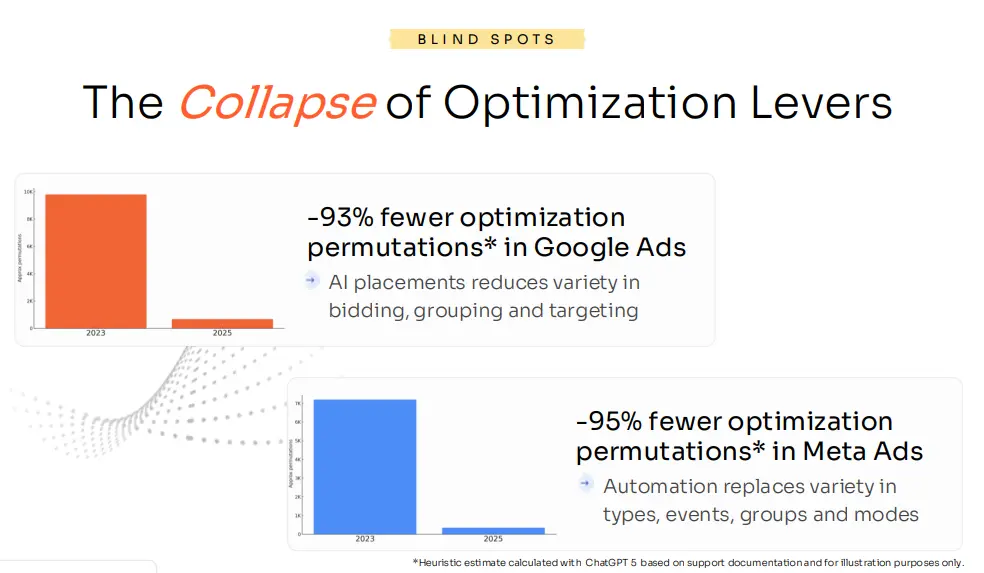
Furthermore, major advertising platforms like Meta and Google have leaned heavily into automation and machine learning optimization. While this often improves campaign performance, it means fewer transparent levers for marketers to manually optimize and more “black box” performance metrics that don’t explain what’s actually driving results.
According to recent WEBSIGH analysis, there are now over 90% fewer optimization permutations available in Google and Meta Ads compared to just 2023. Platforms have consolidated targeting options, eliminated granular controls, and pushed advertisers toward broad automated strategies that work but don’t provide visibility into exactly why they work.
The paradox: Marketing attribution matters more than ever for budget allocation, but the infrastructure supporting accurate attribution seems more broken than it’s ever been.
Identifying Your Critical Attribution Blind Spots
Unfortunately, attribution blind spots don’t announce themselves with warning alerts in your dashboard. You might be staring directly at your analytics reports without noticing that significant traffic and conversions are piling up in areas you’re not tracking at all. Worse, the number of potential blind spots continues growing as marketing channels and customer behaviors evolve.
Here are the major blind spots affecting most marketing teams today:
1. Platform Walled Gardens: The Data Hoarding Problem
Platforms like Google, Meta, Amazon, TikTok, and LinkedIn are extraordinarily powerful advertising channels. However, they’ve become increasingly mysterious about how they attribute conversions as search and social ecosystems evolve. You’re essentially renting their advertising space, but if you don’t play by their ever-changing rules, you won’t receive complete visibility into performance.
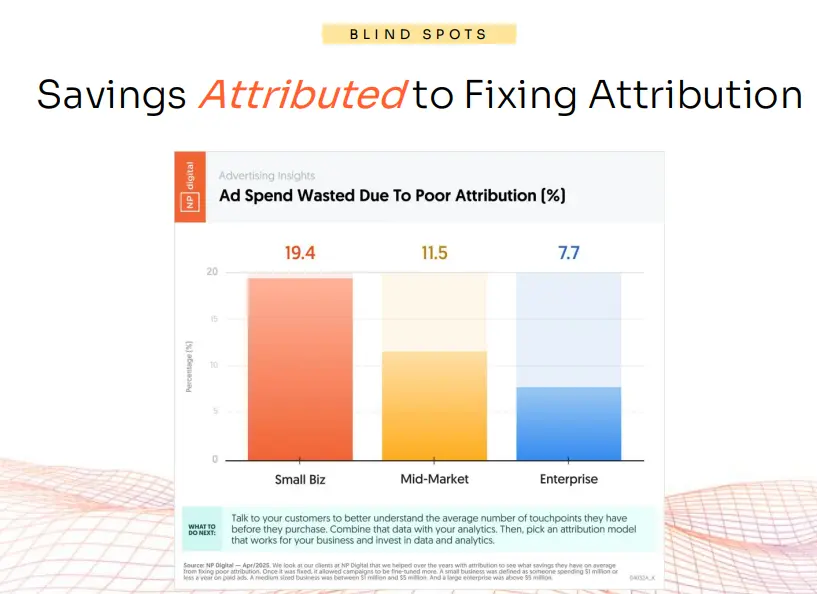
Why this matters: Each platform has its own attribution window, methodology, and reporting system. Consequently, what Google Ads reports as a conversion might be attributed differently in your CRM, and Meta might claim credit for conversions that other platforms also influenced. This creates overlapping attribution where multiple channels claim credit for the same conversion, making it impossible to determine true incremental impact.
The blind spot: Platform-reported conversions often inflate actual business results because they use longer attribution windows and count view-through conversions that may not have genuinely influenced the purchase decision.
2. Offline Sales: Where Digital Journeys End in Physical Locations
Many businesses face a critical disconnect where leads convert through channels their digital analytics can’t track. Prospects might begin their journey by clicking a digital advertisement, but their customer journey ultimately ends at a brick-and-mortar retail location, through a phone call to your sales team, or via an in-person meeting with a representative.
Why this matters: Digital marketing often influences offline sales significantly, but traditional analytics platforms can’t connect these dots without sophisticated integration strategies.
The blind spot: Marketing channels that drive offline conversions (like upper-funnel awareness campaigns) get systematically undervalued in digital-only attribution models, potentially leading to budget cuts for actually effective tactics.
3. Cross-Device Customer Journeys: The Multi-Screen Reality
That advertisement someone viewed on their mobile phone during their morning commute might ultimately convert on their desktop computer at work, their tablet in the evening, or even their smart TV. Modern consumers seamlessly switch devices throughout their day, yet most analytics systems struggle to connect these fragmented interactions into coherent customer journeys.
Why this matters: Single-device attribution models systematically undervalue mobile touchpoints that introduce customers to your brand but don’t immediately convert.
The blind spot: Mobile advertising often gets labeled as “not converting well” when in reality it’s driving awareness that converts on other devices—but your attribution model can’t see the connection.
4. Upper Funnel Awareness Building: The Undervalued Investment
Upper funnel spending on channels like digital out-of-home (OOH), video advertising, podcast sponsorships, and display campaigns routinely gets undervalued in attribution models because these touchpoints rarely lead directly to immediate conversions. However, they play crucial roles in creating the awareness that makes lower-funnel tactics effective.
Why this matters: Cutting upper funnel budgets based on weak direct attribution often causes lower funnel performance to decline weeks or months later as the awareness pipeline dries up.
The blind spot: Attribution models that prioritize direct response metrics systematically favor lower-funnel tactics while underestimating the foundation that upper-funnel spending creates.
5. Dark Social: The Invisible Sharing Economy
Private sharing through channels like WhatsApp, SMS, Slack, Signal, and private Discord servers drives enormous traffic and conversions. However, this activity typically shows up in your analytics as “direct” traffic or gets misattributed to other sources, making it invisible to traditional attribution analysis.
Why this matters: Dark social often represents word-of-mouth recommendations from trusted sources—some of your most valuable marketing. Yet standard attribution models give it zero credit because they can’t see it happening.
The blind spot: When analytics platforms categorize dark social traffic as “direct,” marketers often interpret this as brand strength without realizing it’s actually referral traffic from channels they can’t track.
6. AI Discovery Platforms: The New Search Revolution
Large language models like ChatGPT, Claude, Perplexity, and Google’s AI Overviews are rapidly becoming discovery platforms where users find brand recommendations and product information. These referrals are often completely invisible in standard Google Analytics 4 (GA4) configurations unless you specifically tag and segment them.
Why this matters: AI-driven discovery is growing exponentially, yet most marketing teams have no visibility into this traffic source or its conversion quality.
The blind spot: AI referral traffic often gets miscategorized or lumped into other channels, preventing you from understanding and optimizing for this emerging acquisition channel.
The Compounding Effect: When Blind Spots Stack
These attribution challenges rarely exist in isolation. Instead, they frequently stack and compound, creating nightmarish scenarios where you’re not just missing one data signal—you’re missing combinations of them simultaneously, making optimization exponentially harder.
Example scenario: A prospect discovers your brand through an AI Overview (blind spot #6), shares it via WhatsApp to their colleague (blind spot #5), who later views your Instagram ad on mobile (blind spot #3), then purchases in your retail store (blind spot #2). Your attribution model shows this as “direct” conversion with no marketing influence, even though multiple marketing touchpoints drove the outcome.
Emerging Attribution Trends and Technologies Reshaping Measurement
You can keep pace with these challenges. Success requires shifting your perspective from seeking perfect attribution to building measurement frameworks that provide “good enough” visibility for confident decision-making. Modern marketers should evaluate campaigns using a combination of modelled attribution, traditional touch-based metrics, and experimental validation.
The reality is you may never fully connect every single dot in your customer journeys, and that’s acceptable. Your goal isn’t achieving perfection; it’s gaining sufficient clarity to defend marketing budget allocations and make directionally correct optimisation decisions.
Advanced Attribution Methodologies for 2025
1. Incrementality Testing: Isolating True Lift
Incrementality testing utilises controlled experiments to determine what actually drives business metrics, rather than merely what correlates with conversions. Common approaches include:
Geo holdout tests: Run campaigns in some geographic regions while deliberately excluding others (holdout groups), then measure the performance difference between test and control markets.
Lift studies: Systematically pause specific marketing channels or tactics for controlled periods to measure the impact on conversion volumes and revenue.
Why this works: Incrementality testing reveals the causal impact of your marketing rather than just correlational relationships that might not represent true influence.
2. Marketing Mix Modelling (MMM): The Big Picture View
Marketing Mix Modelling employs statistical analysis to understand how various marketing inputs collectively contribute to business outcomes across all channels simultaneously, including those that are challenging to track digitally.
Best for: Larger marketing budgets (typically $500K+ annually), businesses with substantial offline components, brands running diverse channel mixes.
What it provides: Top-level budget allocation guidance showing how spending shifts between channels would likely impact overall results.
Limitations: MMM operates at aggregate levels and can’t optimise individual campaigns or tactics, requiring complementary approaches for tactical optimisation.
3. AI-Powered Attribution Models: Pattern Recognition at Scale
Machine learning models can identify patterns in customer behaviour data that humans would miss, helping to probabilistically assign credit across touchpoints even when deterministic tracking is impossible.
Applications:
- Predicting which upper-funnel touchpoints most likely influenced later conversions
- Identifying customer cohorts with similar journey patterns
- Forecasting how changes in channel mix would impact outcomes
- Automating attribution model creation and refinement
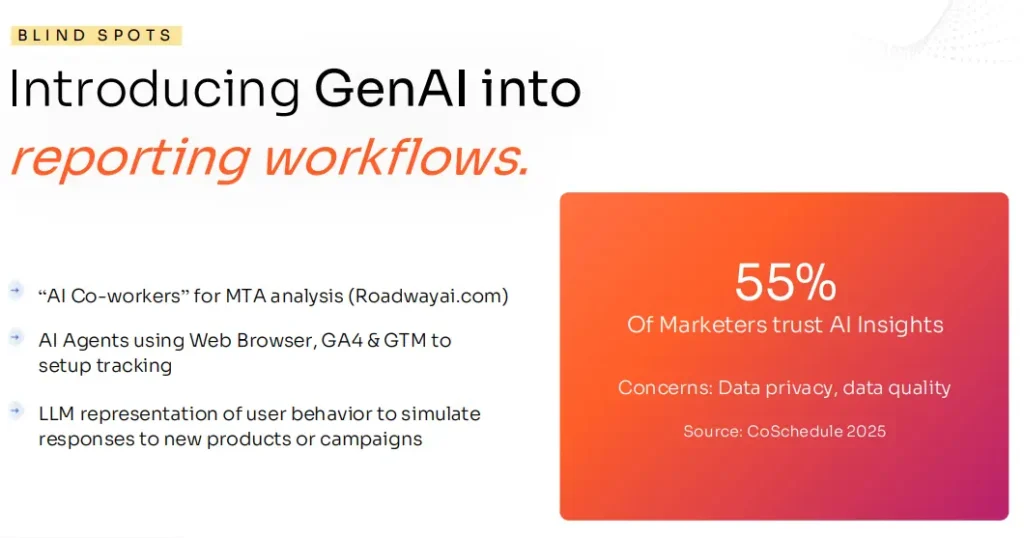
Caution: Only 55% of marketers currently trust AI-generated insights, according to recent CoSchedule research. The key is treating AI as a powerful assistant rather than the ultimate authority. Use it to accelerate testing and build sophisticated models, but always validate findings against your own business data and results.
4. Correlation Analysis and Proxy Signals
When direct tracking isn’t possible, sophisticated correlation analysis can provide directional guidance through proxy signals:
Pre/post analysis: Compare performance metrics before and after specific marketing initiatives launch or pause.
Contextual lift studies: Measure correlated metrics like branded search volume, direct traffic patterns, or social mention velocity that indicate marketing influence even when direct attribution is unavailable.
Survey attribution: Simply asking customers “How did you hear about us?” provides surprisingly valuable directional data despite being self-reported and imperfect.
5. Unified First-Party Data Infrastructure
Building comprehensive first-party data systems that unify information from your CRM, website analytics, advertising platforms, and offline sales channels creates the foundation for any attribution approach to function effectively.
Key components:
- Customer Data Platform (CDP) that creates unified customer profiles
- Clean, consistent data schemas across systems
- Proper identity resolution matching users across devices and channels
- Regular data quality audits and cleaning processes
Blending Methodologies for Maximum Insight
The most effective attribution strategies combine multiple methodologies based on your specific circumstances, spend levels, channel complexity, conversion volumes, and business model. Rather than seeking one perfect solution, build a measurement framework that layers different approaches to close as many blind spots as possible.

How AI Is Both Problem and Solution for Attribution
Some marketers understandably feel that AI is eroding attribution capabilities by introducing new untrackable channels and obscuring platform optimization. While this concern has merit, AI technology is simultaneously helping to rebuild attribution infrastructure in powerful new ways.
AI Attribution Challenges: The Problem Side
AI as discovery platform: ChatGPT, Claude, Perplexity, and other LLMs increasingly drive traffic that doesn’t identify its source unless you specifically configure tracking parameters.
Platform automation black boxes: AI-powered campaign optimization makes decisions without explaining which specific elements drove performance improvements.
Zero-click AI answers: Users get information directly from AI interfaces without clicking through to source websites, making traditional web analytics worthless for these interactions.
AI Attribution Solutions: The Opportunity Side
Unified first-party data: AI-powered CDPs can clean, match, and consolidate customer data across systems more effectively than manual processes, creating better foundations for attribution modeling.
Generative AI for testing: Large language models can simulate user behaviors, test messaging variations, and even help configure GA4 tracking automatically, accelerating your measurement capabilities.
Machine learning models: Advanced algorithms used in Marketing Mix Modeling and platform attribution systems can refine forecasts, assign contribution probabilistically, and generate predictions that improve decision-making even with incomplete data.
AI coworkers: Emerging agentic AI tools can automate attribution model creation, identify anomalies in your data, and surface insights human analysts might miss in complex datasets.
Pattern recognition: AI excels at identifying subtle patterns in large datasets that indicate attribution relationships even when direct tracking is impossible.
Analytics Platform Adaptations
Major analytics platforms are adapting to AI-driven attribution challenges. Adobe Analytics recently released a new referrer type called “Conversational AI Tools” that specifically segments traffic from ChatGPT and other LLMs from historically monitored channels. Consequently, marketers can finally track and analyze AI-driven traffic separately rather than watching it disappear into “direct” or “other” categories.
Expect more analytics platforms to roll out similar AI-specific tracking capabilities throughout 2025 as this traffic source becomes impossible to ignore.
Practical Strategies for Closing Attribution Gaps
So how do you progress from attribution blind spots to better planning and decision-making? You don’t need perfect clarity about every single touchpoint. Instead, you need consistent signals and a smarter measurement strategy that acknowledges modern realities while providing actionable insights.
Here are proven approaches that forward-thinking marketers are using to close attribution gaps:
1. Prioritize First-Party Data Quality and Hygiene
Your first-party data from internal sources like your website, CRM, email platform, and point-of-sale systems represents your most trustworthy information. These sources serve as your primary sources of truth when platform data conflicts or gaps exist.
Action steps:
- Conduct regular data quality audits across all systems
- Implement consistent naming conventions and data schemas
- Build identity resolution processes that connect customer interactions across touchpoints
- Clean duplicate records and standardize formatting
- Establish data governance policies and responsibilities
Why this matters: Attribution models built on poor-quality data produce unreliable insights regardless of how sophisticated your methodology is. Clean data foundations enable everything else.
2. Implement Performance Multipliers Based on Testing
Adjust reported performance metrics based on incrementality tests, geo lift studies, or experimental results. Not every click carries equal incremental value—some represent conversions that would have happened anyway without your marketing intervention.
Action steps:
- Run controlled incrementality tests for major marketing channels
- Calculate “incrementality multipliers” showing what percentage of attributed conversions are truly incremental
- Apply these multipliers to platform-reported metrics for more accurate budget allocation
- Update multipliers quarterly as marketing mix and competitive dynamics evolve
Example: If incrementality testing reveals that only 60% of Meta-attributed conversions are truly incremental (40% would have converted anyway), apply a 0.6 multiplier to Meta’s reported conversion numbers when making budget decisions.
3. Encourage Questions and Model Transparency
Attribution models are sophisticated approximations, not absolute truth. Foster a culture where team members feel comfortable challenging model outputs and suggesting improvements based on business knowledge that data might not capture.
Action steps:
- Document your attribution model assumptions and limitations clearly
- Hold regular attribution review sessions with cross-functional teams
- Actively solicit skepticism and alternative interpretations
- Track prediction accuracy and calibrate models when they diverge from reality
- Admit when model outputs contradict business intuition and investigate why
Why this matters: Blind faith in models leads to poor decisions when model assumptions no longer match reality. Healthy skepticism keeps your attribution relevant.
4. Survey Your Customers About Discovery and Influence
Direct customer feedback about how they discovered your brand and what influenced their purchase decision is surprisingly effective despite being old-school and self-reported. People generally remember major touchpoints even if they forget minor ones.
Action steps:
- Add “How did you hear about us?” fields to checkout and signup forms
- Include attribution questions in post-purchase surveys
- Conduct periodic customer interviews exploring their decision journey
- Analyze patterns in qualitative responses to identify blind spots
- Cross-reference survey data against tracked touchpoints to spot gaps
Tip: Provide specific answer options rather than open text fields to make analysis easier, but always include “Other” with open text for discovering sources you hadn’t considered.
5. Create Trackable Signals Across Dark Channels
Even when you can’t track channels directly, you can create artificial signals that provide visibility into otherwise dark traffic sources.
Action steps:
- Use unique promo codes for different offline marketing tactics
- Create channel-specific landing pages (websigh.com/podcast vs websigh.com/tv)
- Deploy QR codes that route to trackable URLs
- Use distinct phone numbers for different marketing channels
- Implement vanity URLs for offline campaigns
Why this works: While not perfect, these approaches create measurable signals where none existed before, closing partial visibility gaps in your attribution.
6. Configure Custom Channels for AI and Emerging Sources
Modern web analytics platforms allow custom channel definitions that can segment performance from new traffic sources that default configurations don’t properly categorize.
Action steps in GA4:
- Create custom channel grouping for “Conversational AI” traffic
- Tag URLs shared in AI interfaces with utm_source=chatgpt or utm_source=claude
- Configure referrer patterns to automatically categorize AI platforms
- Set up custom reports isolating AI-driven traffic performance
- Monitor AI channel growth and conversion quality separately
Platforms to track specifically: ChatGPT, Claude, Perplexity, Google AI Overviews, Bing Chat, and any emerging AI discovery tools.
7. Build Multi-Touch Attribution Views at Different Levels
Rather than selecting one attribution model, create multiple views showing how different models distribute credit. This provides more complete perspective on channel contribution and effectiveness.
Attribution views to maintain:
- Last-click: Shows direct converters
- First-click: Highlights top-of-funnel introducers
- Linear: Gives equal credit to all touchpoints
- Time decay: Emphasizes recent interactions
- Position-based: Weights first and last touches higher
- Data-driven (if sufficient volume): Uses machine learning to assign credit
How to use: Compare channel performance across multiple models. Channels that perform well across most models are safe bets. Channels that only show value in specific models require deeper investigation.
Connecting Attribution to Business Outcomes That Matter
Attribution exists to inform business decisions, not to create perfect academic models. Understanding where your most profitable leads originate enables growth regardless of your company’s size or industry. Your goal is connecting data to actual strategic decisions around forecasts, budgets, resource allocation, and marketing strategy.
However, with the marketing landscape changing dramatically and rapidly, determining which metrics truly matter becomes challenging. Here are the measurements that drive real business impact:
Metrics That Matter in Modern Attribution
1. Total Conversions and Incremental Conversions
Total conversions: All conversions your tracking captures
Incremental conversions: Only conversions genuinely caused by your marketing
Why the distinction matters: Platforms report total conversions, but you should allocate budget based on incremental conversions after accounting for organic baseline and overlap between channels.
2. Conversion Value Over Time
Track not just conversion counts but the actual revenue or business value generated, and how this evolves as campaigns mature and customer cohorts age.
Why this matters: Some channels drive quick transactional sales while others attract customers with higher lifetime values—understanding this tradeoff is essential for optimal allocation.
3. Cost Per Incremental Conversion
Calculate acquisition costs based on incremental conversions rather than total platform-reported conversions.
Formula: (Total Marketing Spend) / (Incremental Conversions) = True CPA
Why this matters: Using platform-reported CPAs systematically underestimates your true customer acquisition costs and leads to overspending on channels with inflated attribution.
4. Spend Thresholds by Tactic
Identify minimum effective spending levels for each tactic—below which performance declines due to insufficient volume for optimization, and above which diminishing returns set in.
Why this matters: Some tactics require substantial investment to function effectively. Understanding these thresholds prevents wasting money on underfunded tactics that can’t perform.
5. Directional Change Indicators
When you can’t measure absolute impact perfectly, track whether changes in marketing activity correspond with directional changes in business outcomes.
Examples:
- Does pausing a channel cause relevant metrics to decline?
- Does increasing investment correspond with improved results?
- Do competitor spend changes correlate with your performance shifts?
Why this matters: Directional correctness is often sufficient for good decision-making even when you lack precise attribution.
The “Good Enough” Philosophy
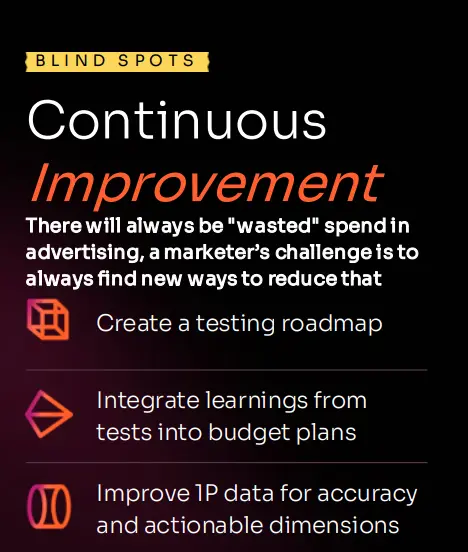
Remember: Even if your attribution models aren’t perfectly accurate, if they consistently guide you toward more optimal spending allocations, they’re working effectively. Continuous incremental improvement in your attribution approach will compound over time, progressively closing gaps and improving decision quality.
Advanced Attribution Strategies for Mature Organisations
Once you’ve implemented foundational attribution improvements, these advanced strategies can provide additional precision and insight:
Unified Measurement Frameworks
Rather than treating platform reporting, web analytics, and offline tracking as separate systems, build unified measurement frameworks that reconcile data across all sources into consistent views of marketing performance.
Components:
- Data warehouse aggregating information from all marketing systems
- Consistent customer identifiers linking touchpoints across platforms
- Regular reconciliation processes identifying and resolving conflicts
- Single source of truth dashboards for decision-making
Closed-Loop Reporting to Sales Teams
Connect marketing touchpoints to sales outcomes by integrating your attribution system with your CRM, enabling analysis of which marketing sources and messages generate the highest quality leads and conversion rates through your sales funnel.
Predictive Attribution Models
Use historical patterns to probabilistically assign credit even when deterministic tracking is impossible, particularly valuable for attributing influence from upper-funnel touchpoints to eventual conversions.
Portfolio Attribution Approaches
Treat your marketing mix like an investment portfolio; some channels provide stable baseline returns while others drive growth but with higher variance. Optimise the portfolio mix rather than expecting every individual tactic to show perfect direct attribution.
Your Attribution Improvement Roadmap
Ready to close your attribution blind spots systematically? Follow this proven implementation sequence:
Phase 1: Assessment (Weeks 1-2)
- Audit current attribution model and known limitations
- Identify your biggest blind spots based on business model
- Document conflicting data sources and reporting discrepancies
- Survey stakeholders about decision-making needs
Phase 2: Foundation (Weeks 3-6)
- Clean and consolidate first-party data sources
- Implement consistent tracking and naming conventions
- Configure custom channels for AI and emerging sources
- Set up basic incrementality tracking framework
Phase 3: Advanced Measurement (Weeks 7-10)
- Launch incrementality tests for major channels
- Implement Marketing Mix Modelling if appropriate for scale
- Build multi-touch attribution view dashboards
- Deploy customer survey attribution questions
Phase 4: Optimisation (Weeks 11-12)
- Calculate performance multipliers based on test results
- Adjust budget allocations based on new insights
- Document attribution model assumptions and limitations
- Establish a quarterly review and refinement process
Ongoing: Continuously test assumptions, refine models, and adapt to new channels and customer behaviours as they emerge.
Transform Your Attribution Strategy with Expert Guidance
Modern marketing attribution requires sophisticated thinking that balances technical precision with pragmatic business decision-making. The goal isn’t achieving perfect measurement; it’s building frameworks that provide sufficient insight for confident budget allocation and strategic planning despite inevitable blind spots and data limitations.
Many organisations struggle to implement effective attribution because they lack either the technical analytics expertise to build sophisticated models or the strategic marketing experience to design frameworks that match actual business decision needs. That’s where partnering with experienced measurement specialists can dramatically accelerate your progress and prevent costly missteps.
Let WEBSIGH Build Your Comprehensive Attribution Framework
WEBSIGH’s Attribution Services Include:
✓ Complete attribution audit identifying your specific blind spots
✓ Unified measurement framework design and implementation
✓ Incrementality testing strategy and execution
✓ Marketing Mix Modelling for appropriate budgets
✓ First-party data consolidation and quality improvement
✓ Custom analytics configuration for AI and emerging channels
✓ Cross-functional training on attribution interpretation
✓ Ongoing optimisation and model refinement
Start Making Data-Driven Decisions with Confidence:
📧 Email: info@websigh.com
📞 Phone: +91 (700) 880-7871
🔗 Get Your Free Email Workflow Audit: Fill the form below, and we will get back to you.
Don’t let attribution blind spots lead to poor budget decisions and missed growth opportunities. The marketing organisations thriving in 2025 are those that acknowledge modern attribution challenges while building pragmatic measurement frameworks that enable confident strategic choices. Let WEBSIGH help you build attribution systems that work in today’s fragmented reality.
The technology that we use to support you
Ready to reduce your technology cost?

See More Blogs





Let's Make Something Impactful
Call us at: 700-880-7871
- Client-oriented
- Independent
- Competent
- Results-driven
- Problem-solving
- Transparent