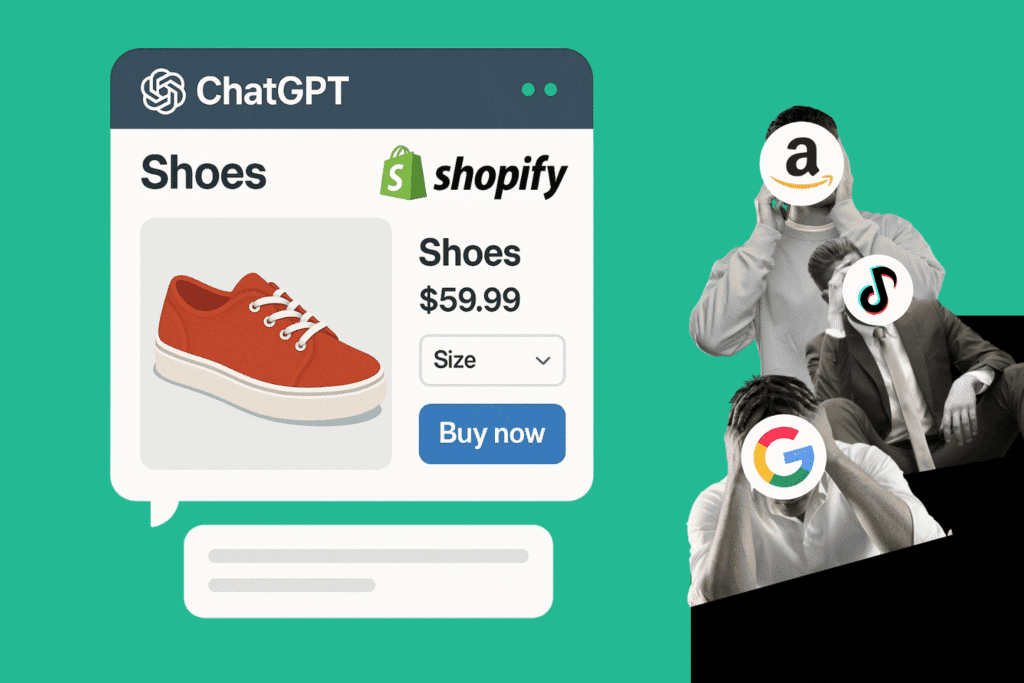
You can now purchase products directly within ChatGPT, no browsing multiple sites, no endless comparison shopping, no switching between tabs.
OpenAI recently launched a feature that transforms ChatGPT into a personal shopping assistant. You ask for something, and it recommends products, displays pricing, and even helps you complete checkout, all within a single conversation.
They’re calling it Instant Checkout, rolling out through partnerships with e-commerce giants like Stripe, Shopify, and Walmart. The feature enables OpenAI to pull real-time product listings and deliver personalised suggestions based on natural language conversations.
This is a major shift for e-commerce brands. Shopping now happens entirely within a conversational interface, from initial product discovery through final purchase. Moreover, with ChatGPT advertising already launching, we’re witnessing the emergence of a completely new commerce channel.
At WEBSIGH, we’re helping e-commerce clients optimise for this conversational commerce revolution. The brands that adapt quickly will capture early-mover advantages in this rapidly growing channel.
How ChatGPT Shopping Actually Works
ChatGPT’s Instant Checkout feature is powered by integrations with Stripe and Shopify, with Walmart as a launch partner. The service is available to all U.S. ChatGPT users regardless of subscription tier.
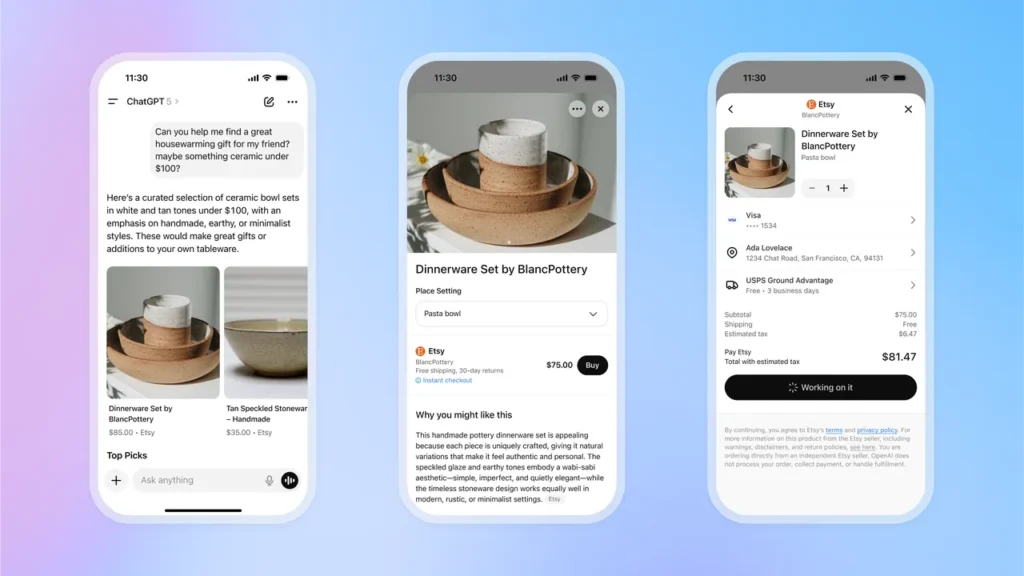
The User Experience
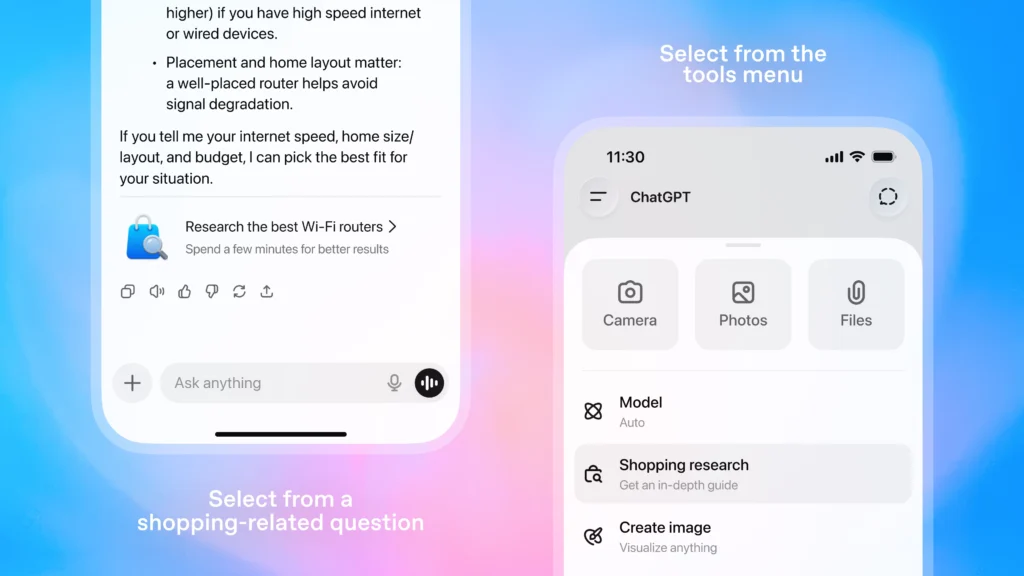
Instead of traditional search and browse patterns, users interact through natural conversation:
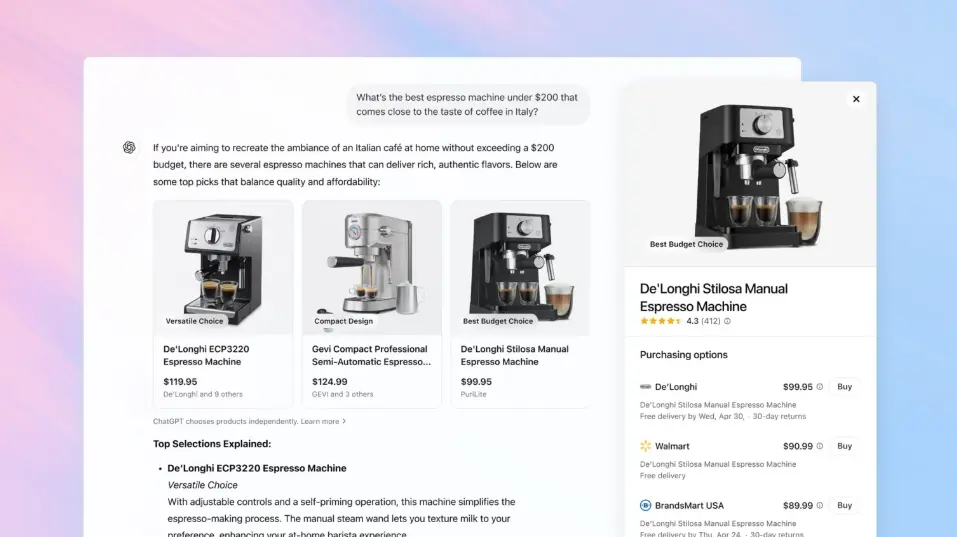
User: “Find me espresso machines under $200”
ChatGPT provides:
- Curated product suggestions from major retailers
- Real-time pricing and availability
- Product cards with images, links, and reviews
- Direct checkout options (for partner retailers)
The experience shifts from “browse and compare” to “ask and buy.” Furthermore, users refine searches conversationally: “What about ones with milk frothers?” or “Show me highly-rated options.”
P.S WIRED has published a cool blog on this, you can read that here – link
How Products Get Selected
ChatGPT analyzes structured product metadata, reviews, and pricing to determine recommendations. Unlike Google Shopping’s ad-based or algorithm-driven results, ChatGPT shopping prioritizes conversational relevance and user intent signals extracted from the dialogue.
Personalization is key: If you mention a $50 budget, ChatGPT filters results accordingly. If you prefer specific brands or features, it remembers and adjusts recommendations throughout the conversation.
Why This Changes E-Commerce Fundamentally
ChatGPT isn’t just adding shopping capabilities—it’s rewriting how people discover and buy products.
Discovery Becomes Conversational
Traditional search requires product-focused keywords. ChatGPT handles context-rich prompts like:
- “I need a thoughtful gift under $50 for a coworker who loves coffee”
- “What are comfortable sneakers for walking in Europe this winter?”
These natural language queries allow AI to interpret intent and context that keyword search misses entirely. Consequently, brands with clear product data and natural descriptions will dominate this environment.
Product Pages Drive Visibility
AI pulls data directly from your product listings, descriptions, schema markup, and reviews. If your content is outdated, poorly structured, or missing key information, you won’t appear in ChatGPT shopping results at all.
With frictionless purchasing reducing decision time, your product page clarity and trust signals directly impact conversion rates. This represents the next frontier of AI in e-commerce, showing up when customers ask questions in natural language.
Optimizing Your Products for ChatGPT Shopping
If you want your products to appear in ChatGPT recommendations, your product pages need more than attractive images and competitive pricing. You need structure, clarity, and AI-readable content.
1. Implement Product Schema Markup
Structured data helps AI understand your product pages. Add product schema including:
- Price and availability
- Review ratings and count
- Product name and images
- Key specifications
Why this matters: Without schema markup, you’re invisible to AI recommendation engines. This is your foundation for ChatGPT visibility.
2. Write Natural, Benefit-Focused Descriptions
ChatGPT prioritises conversational content that sounds like how people actually talk about products.
Don’t: “Ergonomic, breathable mesh back with tilt-lock feature”
Do: “Keeps you cool and comfortable during long workdays”
Focus on the benefits customers care about rather than technical specifications. Save detailed specs for a separate section.
3. Use Clear, Searchable Product Names
Avoid overly clever names that don’t match how people search.
Weak: “The Cloudstep LX”
Strong: “Men’s Waterproof Running Shoes – Cloudstep LX”
Lead with what the product is, then include your brand name. This helps both AI and humans understand what you’re selling.
4. Maintain Fresh Reviews and Ratings
Recent social proof helps AI understand what’s worth recommending. Keep reviews visible, respond to customer feedback, and encourage new reviews regularly. AI models heavily weight review recency and sentiment.
5. Optimise Mobile Page Speed
Slow pages kill conversions, especially for impulse purchases in conversational commerce. Optimise images, reduce scripts, and test load times on mobile devices to ensure seamless experiences.
Target: Under 2 seconds for mobile page load.
What E-Commerce Brands Should Do Now
ChatGPT shopping is still early, but smart brands are preparing now:
Week 1-2: Audit and Prepare
- Review your product page structure and content quality
- Identify gaps in schema markup implementation
- Analyze product descriptions for conversational language
- Check mobile site performance
Week 3-4: Implement Optimization
- Add or update product schema across key pages
- Rewrite product descriptions with natural language
- Optimize product naming conventions
- Implement mobile speed improvements
Ongoing: Monitor and Refine
- Track if/when your products appear in ChatGPT
- Gather customer feedback on discovery methods
- Stay updated on OpenAI partnership announcements
- Test product queries in ChatGPT regularly
The Future of Conversational Commerce
ChatGPT shopping represents a new channel, not just a feature update. Conversation is replacing search bars, and product discovery happens through real-time AI recommendations rather than manual browsing.
For e-commerce brands, adaptation isn’t optional. Optimize your product pages with schema markup, write content that matches natural speech patterns, and ensure your technical foundation supports AI discovery.
Your potential customers are already chatting with AI. The critical question: Is your brand ready to be part of that conversation?
Let WEBSIGH Optimize Your E-Commerce for AI Shopping
WEBSIGH’s Conversational Commerce Services:
✓ Product page optimization for AI discovery
✓ Schema markup implementation
✓ Conversational content strategy
✓ Mobile performance optimization
✓ AI visibility monitoring and refinement
Your Attribution Improvement Roadmap
Ready to close your attribution blind spots systematically? Follow this proven implementation sequence:
Phase 1: Assessment (Weeks 1-2)
- Audit current attribution model and known limitations
- Identify your biggest blind spots based on business model
- Document conflicting data sources and reporting discrepancies
- Survey stakeholders about decision-making needs
Phase 2: Foundation (Weeks 3-6)
- Clean and consolidate first-party data sources
- Implement consistent tracking and naming conventions
- Configure custom channels for AI and emerging sources
- Set up basic incrementality tracking framework
Phase 3: Advanced Measurement (Weeks 7-10)
- Launch incrementality tests for major channels
- Implement Marketing Mix Modelling if appropriate for scale
- Build multi-touch attribution view dashboards
- Deploy customer survey attribution questions
Phase 4: Optimisation (Weeks 11-12)
- Calculate performance multipliers based on test results
- Adjust budget allocations based on new insights
- Document attribution model assumptions and limitations
- Establish a quarterly review and refinement process
Ongoing: Continuously test assumptions, refine models, and adapt to new channels and customer behaviours as they emerge.
Get Ready for ChatGPT Shopping:
📧 Email: info@websigh.com
📞 Phone: +91 (700) 880-7871
🔗 Free E-Commerce AI Readiness Audit: Fill the form below, and we will get back to you.
Don’t let competitors capture early-mover advantages in conversational commerce. WEBSIGH helps e-commerce brands optimise for AI-powered shopping before it becomes saturated.
The technology that we use to support you
Ready to reduce your technology cost?

See More Blogs


Let's Make Something Impactful
Call us at: 700-880-7871
- Client-oriented
- Independent
- Competent
- Results-driven
- Problem-solving
- Transparent